Birds · Book 1
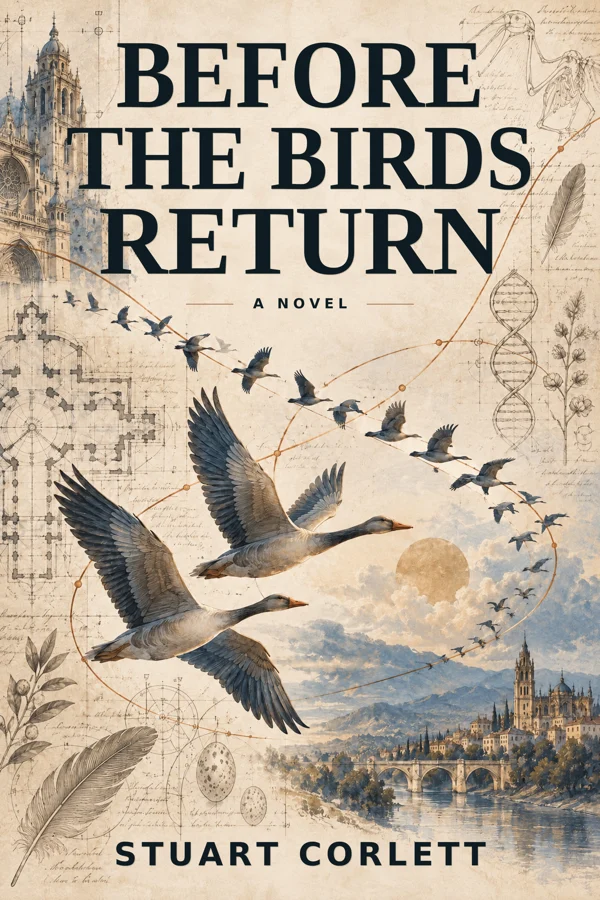
Before the Birds Return
A discovery beneath a Spanish cathedral draws a scientist and an Alaskan pilot into an influenza mystery—and back towards the love they once abandoned.
View book
Birds · Book 2 · Stuart Corlett
The sequel to Before the Birds Return
An old photograph should not change when the light moves.
When Anneliese notices an impossible detail in the image of a pale optical plate, a forgotten collection near Davos draws her and Gabriel into a mystery that reaches far beyond its damaged frame. Fine markings, a family notebook, and an unexpected biological clue suggest that the object may hold information its discoverers were never meant to find.
As the evidence begins to yield answers, the discovery attracts people with very different reasons to believe. For a family living with memory loss, an intriguing experiment becomes the promise of something much more personal. For those seeking control of the archive, uncertainty is an obstacle to be removed.
With access running out, Anneliese must decide what she can honestly claim—and what she is willing to risk to keep hope from becoming a lie.
What the Earth Remembers is a novel of hidden knowledge, fragile memory, and the difficult courage of telling the whole truth.
Read before you choose
Chapter 1 — The wrong light
Anchorage • February 6, 2027
The scratch had moved.
Anneliese went back to the first photograph. There it lay along the lower edge of the pale object, thin and grey, an imperfection she had stopped seeing after the first week. In the second image it broke into small bright intervals. The ruler beside it had not moved. Neither had the curled corner of the paper label.
Behind the laptop, the kitchen window held the blue of an Anchorage morning before sunrise. Someone down the street was scraping ice from a windshield, the strokes coming through the double glass as a small, patient sound.
A dark line. A row of lights.
“Before you break the screen with your forehead,” Gabriel said, “would you like me to make it larger?”
He stood across the table with his sleeves pushed back and flour on his wrist. Behind him lay the remains of an attempt at pancakes that had become more serious than either of them intended.
“This one arrived last night.” She opened the new image. “Lucile found another envelope.”
The first photograph had come just before Christmas, the evening they listened to Vivienne’s finished sound piece. Three shallow arcs, a slanting stroke across them, the beginning of a hook. It resembled a mark documented during the previous year’s investigation. How much depended on the size of the image and how badly she wanted the resemblance to matter.
For seven weeks Valeria had been doing the work that wanting could not do. She had established the sender’s identity and followed the modest history of a box that had moved through two houses and a damp garage. Nobody knew where the object was. Nobody had a reliable date for the image.
Lucile Besson had found the new photograph behind a portrait of her grandfather. She had sent the whole envelope, then apologised because the writing on it concerned a broken washing machine. Anneliese understood the apology. People expected an important object to have been kept importantly.
“Same position?” Gabriel asked.
“Almost. Look at the paper.”
A small label rested against the frame around the pale plate, one corner lifted, casting a triangular shadow. In both photographs the shadow pointed the same way.
“The light’s different,” Gabriel said. “So it could be the same scratch.”
“Yes.”
She enlarged the image until the frame became a stairway of pixels. Along the pale band, the bright intervals widened, blurred, and separated again as she changed the scale.
End of sample · © Stuart Corlett
Keep exploring
A discovery beneath a Spanish cathedral draws a scientist and an Alaskan pilot into an influenza mystery—and back towards the love they once abandoned.
View bookBirds: The End
After What the Earth Remembers, the Birds series branches here. These books are alternative finales—not consecutive sequels. Choose either ending, or read both.
The hopeful ending
Anneliese, Gabriel and their companions face a world under pressure. In this hopeful Birds finale, cooperation gives humanity a path toward peace.
View bookThe darker ending
Political pressure turns protection into a test of loyalty. In this darker Birds finale, Anneliese, Gabriel and their companions struggle to preserve love as civilization fragments.
View book
